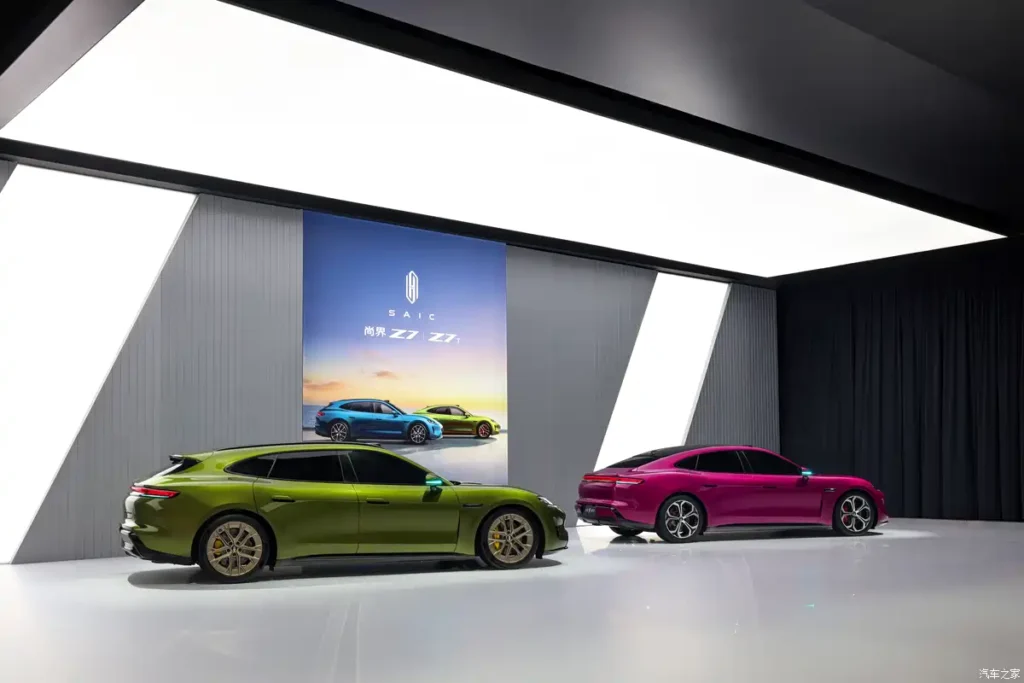
A Bold Entry into the Mid-to-Large Electric Wagon Segment
The Chinese EV market rarely stands still, and March 23rd brought another headline-worthy debut. AITO’s Shangjie Z7T officially opened its pre-sale window with a starting price of 239,800 RMB (approximately $33,000 USD). Early reservation holders can unlock up to 11,000 RMB in purchase benefits, including a 5,000 RMB option credit and a limited-time free color upgrade to either “Electric Light Purple-Pink” or “Evening Mountain Green” - both valued at 6,000 RMB.
What makes the Z7T stand out isn’t just its eye-catching shooting brake silhouette. This vehicle ships with five core Huawei technologies as standard across every trim level: the Huawei ADS 4.1 intelligent driving system, the Qiankun smart driving platform, the (Tuling) chassis platform, the Huawei Giant Whale battery platform, and Huawei’s HarmonyOS Cabin. In an era where automakers often gate premium tech behind expensive packages, the Z7T’s “standard is fully loaded” approach is genuinely refreshing. For a deeper look at the full spec sheet and pricing tiers, check out this resource covering the launch details.
—
Design and Dimensions: Style Meets Substance
The Z7T carries over the front-end design language from the Shangjie Z7, but the shooting brake roofline gives it a distinctly sportier, more aggressive presence. At 5,036mm long, 1,976mm wide, and 1,465mm tall, with a 3,000mm wheelbase, it sits firmly in the mid-to-large vehicle category - big enough to command road presence, low enough to look planted and purposeful.
Up front, the headlights feature 408 individual laser light points arranged in a split-lens optical architecture, producing a dramatic starfield effect that’s hard to miss at night. Active air intake grilles flank the lower fascia, and a LiDAR unit is roof-mounted - a clear signal that this car is built around its autonomous driving capability from the ground up.
The rear is equally considered. The gently sloping tail creates a full, fastback silhouette, while the taillights mirror the front’s starfield theme. A rear diffuser rounds out the sporty aesthetic. The result is a vehicle that feels cohesive and deliberate - not like a crossover that had a wagon body grafted onto it as an afterthought.
—
Interior Technology and Living Space
Step inside and the Z7T leans hard into tech-forward cabin design. There’s a large floating center touchscreen paired with a dedicated front-passenger display, but the real headline is the world-first “four-dimensional follow screen” - a display that can extend forward and backward, rotate left and right, automatically pivot toward the active user, and respond to voice commands through Huawei’s Xiao Yi assistant. It’s the kind of interaction model you’d expect from a concept car, showing up in a production vehicle.
The front-passenger screen can also render animated pet characters - a small touch, but one that speaks to the lifestyle-oriented, younger demographic the Z7T is targeting.
Health-conscious buyers get the ALPS Healthy Cabin 2.0 system, which uses MOF (metal-organic framework) adsorption materials to actively degrade pollutants inside the cabin. The first-ever water-ion air conditioning system adds another layer, providing moisturizing, antibacterial, and anti-allergen benefits during every drive. Cargo practicality hasn’t been sacrificed either - maximum boot volume reaches 1,694 liters, making this a genuinely usable long-haul touring vehicle.
—
Powertrain, Range, and Why This Car Deserves Your Attention
Under the hood - or rather, under the floor - the Z7T offers two powertrain configurations. The single-motor rear-wheel-drive variant produces 359 hp (264 kW), while the dual-motor all-wheel-drive version pushes 590 hp (434 kW). Battery options include 81 kWh and 100 kWh CATL ternary lithium packs, with the top-spec configuration achieving a CLTC-rated range of 905 km.
The autonomous driving hardware is equally serious. The next-generation 896-line dual-optical LiDAR offers four times the resolution of previous units and can detect objects as small as 14 cm in height at long range. Combined with Huawei ADS 4.1, the Z7T promises smarter, smoother, and safer navigation in both urban and highway environments.
If you’re tracking how AI and sensor fusion are reshaping the automotive space, this page is worth bookmarking for ongoing updates on vehicles like the Z7T.
The Shangjie Z7T makes a compelling case for buyers who want long-distance touring capability, cutting-edge autonomous driving, and a design that doesn’t look like every other electric SUV on the road. For the full specs, configuration options, and pre-order details, visit the official listing and see whether the Z7T fits your next vehicle shortlist.
Compare Recommended Products
| Product | Best For | Fitment | MOQ | Use Case | Action |
|---|
Looking for EV accessories for your market?
Tell us your target market, vehicle model and quantity. We will match suitable products from China.