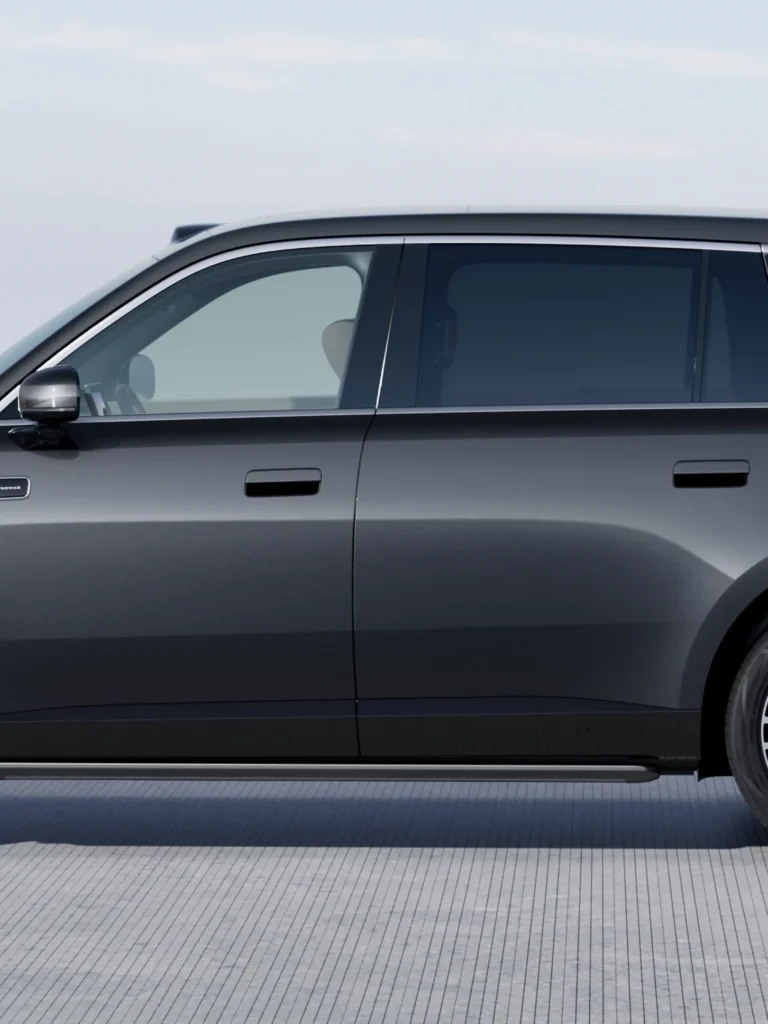
Xiaomi has used its latest SkyNomad Q&A to spell out what the new series is, why it exists, and how it differs from the company’s SU7 and YU7 line. The short answer is that SkyNomad is not a sub-brand. It is Xiaomi Auto’s second product series, positioned as a large-space SUV family built around how people live inside the vehicle, not just how it drives.
That distinction matters. Xiaomi says SU7 and YU7 are the company’s driving-focused series, aimed at making the car safer, smarter, and easier to control. SkyNomad, by contrast, is framed as the “intelligent reconfigurable large-space SUV” series. On the company’s official SkyNomad landing page, Xiaomi describes the vehicle as a mobile world that can shift between use cases: a one-person workstation, a two-person cafe, a three-person lounge, or a family playroom. In other words, the brand is trying to define a cabin concept first and a vehicle shape second.
A second series, not a spin-off brand
Xiaomi’s latest explanation also clarifies branding. SkyNomad carries the MI logo on the nose, just like the rest of the Xiaomi Auto lineup. The company says the three series share the same standards for R&D, quality, safety, sales, delivery, service, and manufacturing. That is why Xiaomi is careful to frame SkyNomad as a parallel series rather than a separate sub-brand.
The logic, according to Xiaomi, comes from the company’s broader “Human x Car x Home” strategy. The maker says it began its car business by tackling a pure electric sedan first, because that was the hardest technical starting point. Five years later, with SU7 and YU7 outperforming expectations, Xiaomi says it now has enough experience in design, engineering, safety, and manufacturing to enter the large-space SUV segment with a different product philosophy.
By April 23, 2026, Xiaomi said cumulative deliveries had exceeded 655,000 vehicles. It also said SU7 led China’s 20万元-plus pure electric sedan retail market in 2025, while YU7 was the top SUV seller in China in the January-April 2026 period. Those results are part of the company’s rationale for expanding the portfolio rather than merely stretching the existing one.
What Xiaomi is actually building
SkyNomad is being developed on Xiaomi’s Kunlun architecture, a platform the company says began in early 2023 specifically to support a flexible SUV layout. The key hardware idea is a flat floor combined with long sliding rails, which Xiaomi says unlocks “space switching” inside the cabin. That is the core of the product message: not a bigger SUV for its own sake, but a cabin that can be rearranged for different lives and different family patterns.
In the official Q&A, Xiaomi said SkyNomad is currently planned in two body styles: a five-seat version and a seven-seat version. Both will use range-extended powertrains. The five-seat and seven-seat layouts are meant to address different use cases, from daily commuting to long-distance family trips. Xiaomi says the point is to make each version feel naturally suited to a different household, instead of forcing one configuration to do everything.
The company also explained why it chose range extension for this series. Xiaomi says many users still want longer one-charge driving range and more flexible refueling options because charging access, commute patterns, and living conditions vary widely. The brand’s answer is not “an EV with a fuel tank,” but a system that maximizes the pure-electric experience while keeping long-distance anxiety low.
That approach has already produced concrete announcement figures. Xiaomi says the SkyNomad series will achieve up to 380 km of WLTC pure-electric range, with a lowest WLTC fuel consumption figure of 5.7L/100km. On the China-specific CLTC cycle, the company says pure-electric range exceeds 500 km. Those are official announced figures, not road-test results, and they should be read as Xiaomi’s own certification claims rather than independent measurements.
Testing at an extreme level
Xiaomi says SkyNomad has been given a testing programme that is larger than many expected for a first-time range-extended SUV. Across the full Xiaomi Auto lineup, the company says it has deployed 2,684 test vehicles and covered more than 35.51 million km across 300-plus cities as of June 30, 2026. For SkyNomad specifically, Xiaomi says it has already used 566 test vehicles and covered more than 4.28 million km.
The test conditions sound intentionally severe. Xiaomi says the programme has run from -41C to 53C and has reached an altitude of 5,380 metres in Ngari, Tibet. The company also says it has carried out dedicated structural durability, powertrain durability, and overall endurance tests because this is its first range-extended vehicle. The message is clear: SkyNomad is being positioned as a serious engineering project, not a design study.
What remains open is launch timing. Xiaomi says the rollout is progressing, but it has not yet announced a firm on-sale date. For now, the company is using the official SkyNomad page and its Q&A answers to shape expectations: two body styles, a large-space cabin, range-extended power, and a product story built around flexibility rather than outright performance.
Source: Yiche report; Xiaomi SkyNomad official page.
Compare Recommended Products
| Product | Best For | Fitment | MOQ | Use Case | Action |
|---|
Looking for EV accessories for your market?
Tell us your target market, vehicle model and quantity. We will match suitable products from China.